
I've interviewed in English twice, three years apart, and the two experiences could not have been more different.
The first was in August 2022, over video, with a Vietnamese CTO. The technical part was in Vietnamese. The English part was only an introduction: my name, my age, my experience. I stumbled and paused constantly. I got the job anyway, probably because the company cared more about engineering skills. But I knew that if the person asking had been a foreigner, I would not have passed.
The second was in 2025. I met a German CEO in person, then interviewed over Google Meet with an Indian CTO. Presenting, explaining, solving problems, doing a test, all in English. This time it went smoothly. Not because I had suddenly become fluent, but because I prepared in a very specific way: I imagined every scenario that could come up, practiced alone, then practiced with the recruiter who had referred me.
I tried ChatGPT for practice back then, but it talked too fast and jumped in whenever I paused to think. I wished I had an AI that would play the hiring manager, ask the questions that fit the role I was applying for, and wait patiently for my answer. That's one of the reasons I built Chamate. This guide is the way to practice English job interviews with AI that I wish I'd had in 2022, with a 7-day plan, the questions you'll almost certainly get, and the mistakes non-native speakers make most.
Why Interviews Are Harder Than Everyday Conversation
Plenty of people chat in English with friends just fine, then freeze in an interview. Their English didn't get worse. It's that an interview stacks the hardest parts of speaking on top of each other:
- Pressure. Someone is evaluating you, and the outcome affects your income.
- Unexpected questions. You don't know what's coming, and there's no time to look anything up.
- Long, structured answers. “Tell me about yourself” needs one to two coherent minutes, not a few short sentences.
- Professional vocabulary. You have to explain your own work using words you may have only ever used in your native language.
- The memorizing habit. Many learners write answers out and learn them by heart. The moment the interviewer steers slightly off script, they're lost.
So interview practice isn't just English practice. It's practice speaking under pressure, about your own field, answering questions you can't predict. If you're still at the stage where finishing a sentence is hard, read how to practice English speaking with AI first, and come back here once you can talk for ten minutes straight.
AI vs. Practicing Alone vs. Practicing with a Friend
In 2025 I used all three: alone, with ChatGPT, with a recruiter. Each solves part of the problem, and this is what I took away.
| Alone, in the mirror | Friend or recruiter | AI as the interviewer | |
|---|---|---|---|
| Unexpected questions | None, you ask and answer yourself | Yes, but they don't know your job description | Yes, and tied to the job description if you paste it in |
| How many sessions | Unlimited | One or two; asking for more gets awkward | Unlimited, whenever you feel like it |
| Corrections | You listen back, easy to miss things | They're reluctant to correct you, and don't really listen for grammar | Every sentence, saved for review |
| Real pressure | Almost none | Yes, closest to the real thing | Some: there's someone asking and waiting for your answer |
| Hearing the question again | Not applicable | You can't ask them to repeat forever | Replay as many times as you like |
My conclusion: AI is where you get volume, real people are where you check quality. Do five to seven sessions with AI, then one or two final sessions with a friend or recruiter. I'll cover the real-person part at the end. The same setup works for exams too, see practice IELTS Speaking with AI. If you want the full picture of where ChatGPT Voice falls short for speaking practice, see how to practice English speaking with ChatGPT.
Setting Up a Mock Interview with AI in 4 Steps
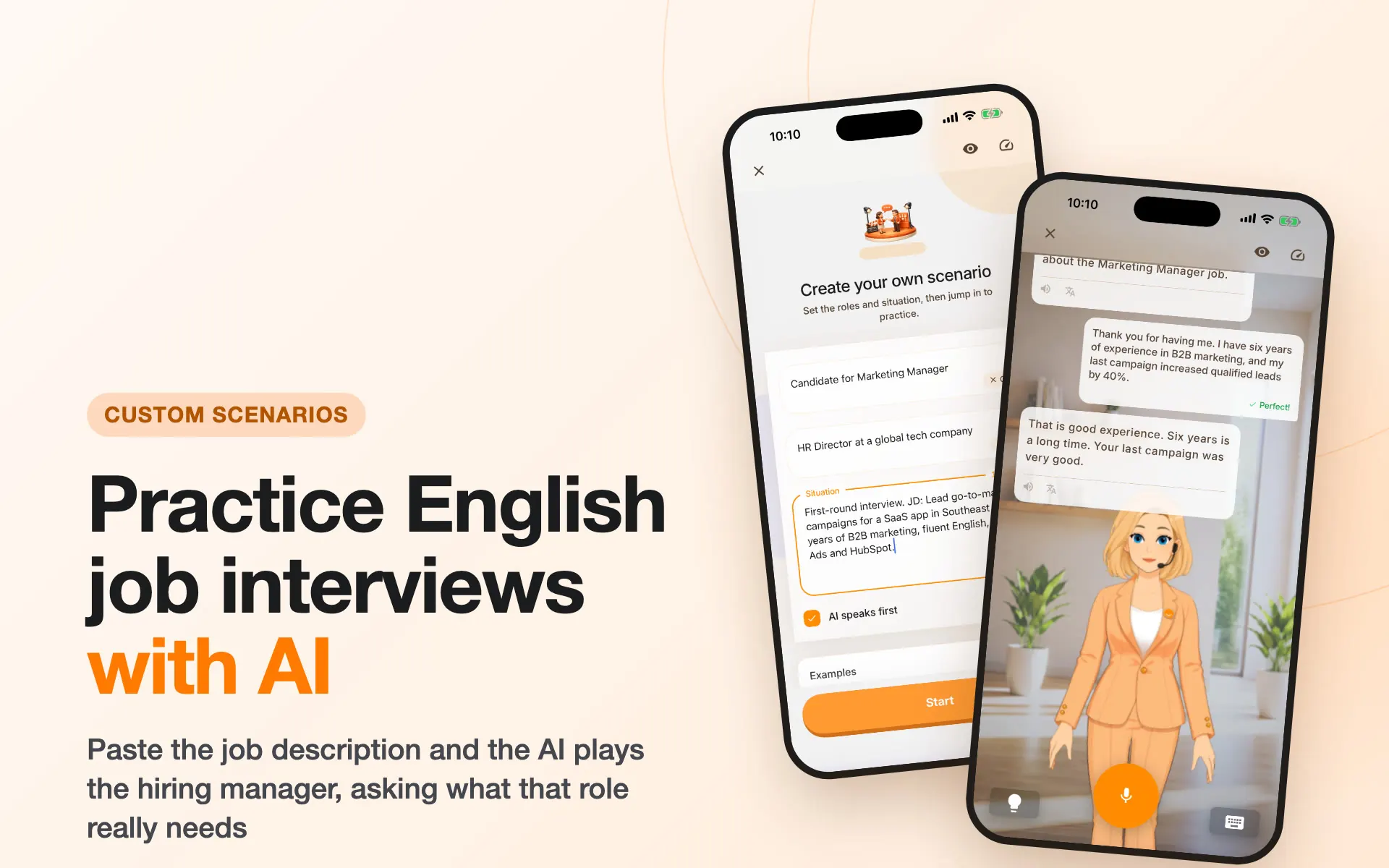
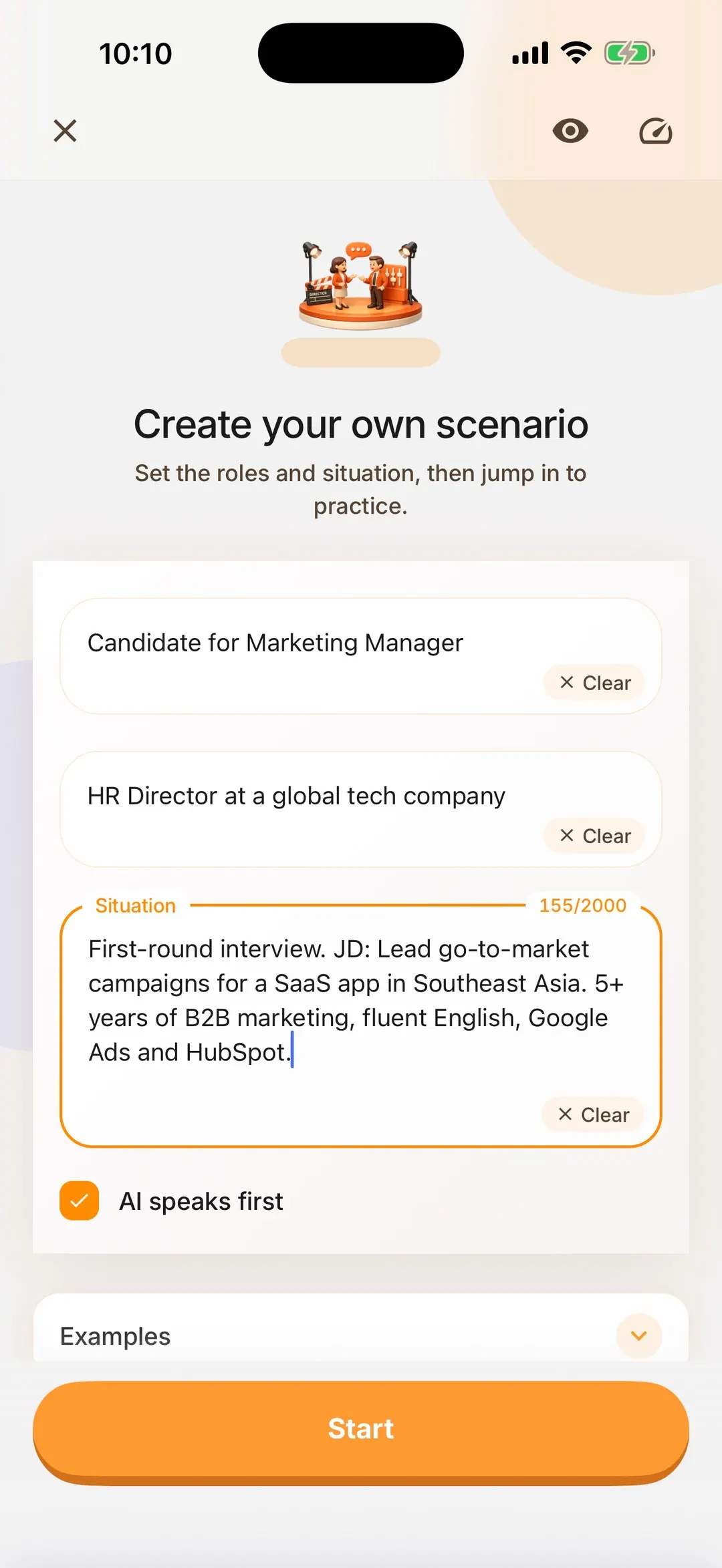
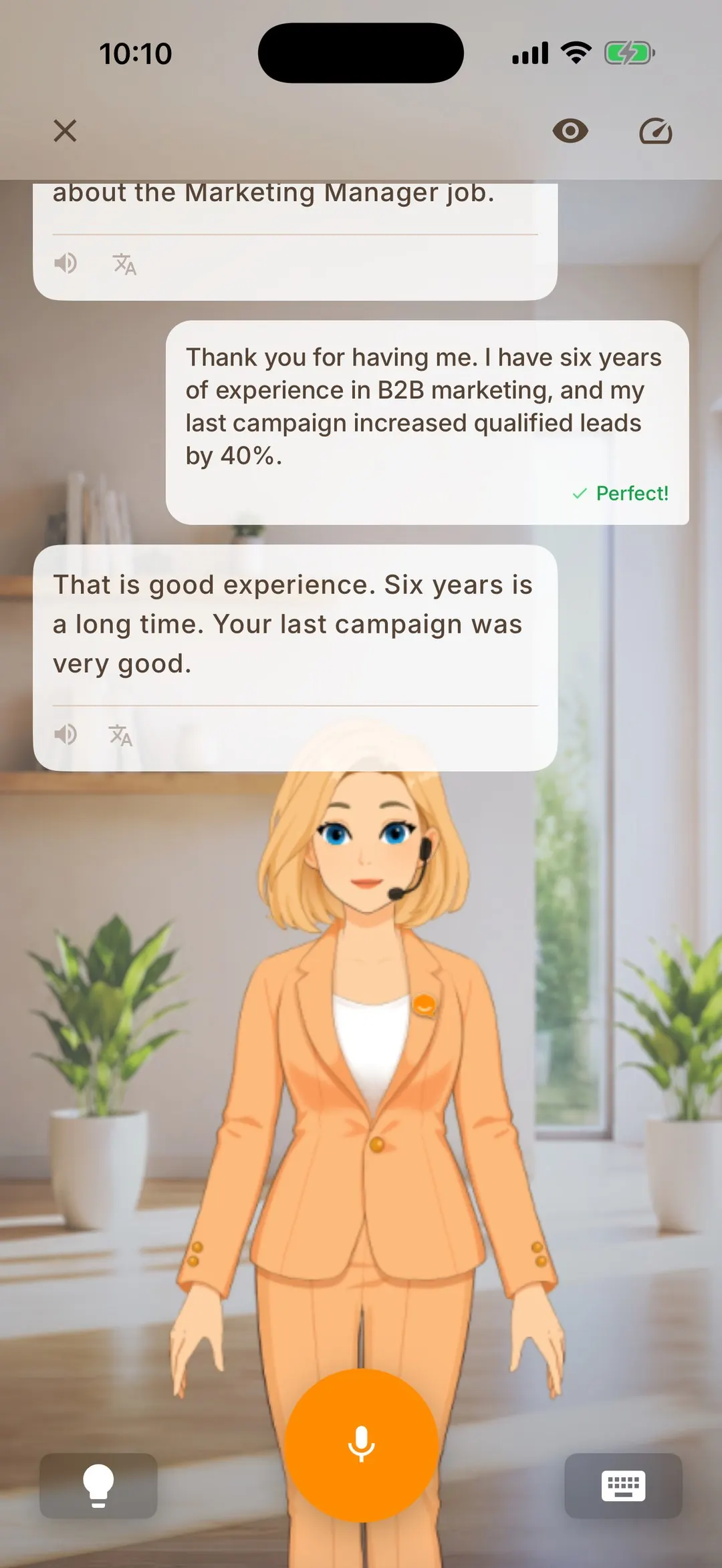
In Chamate this feature is called custom scenarios: you fill in your role, the AI's role and the situation, then tap Start. How you fill in those boxes decides whether the session feels real, so let me go box by box.
Step 1: Your role
Be specific about the position, not just “candidate”. For example: “Candidate for Marketing Manager” or “Backend developer with 3 years' experience applying for a Senior role”. The AI uses this to pitch its questions at the right level.
Step 2: The AI's role, and say whether it's HR, a team lead or the CEO
This is the step most people skip. Who the interviewer is changes the questions completely. HR asks about motivation, strengths and weaknesses, salary, why you left your last job. A team lead or CTO asks about your craft and how you handled specific situations. A CEO asks about vision and how well you understand the company. Since it's a language model, whatever you write is who it becomes: “Head of HR at a tech company”, “Indian CTO who digs deep into technical details”, “German CEO, final round”.
Tip: at many international companies, the first round is an HR screen with a few basic English questions, and only later rounds are with the people you'll actually work with. Set up both, because the questions and the pace are different.
Step 3: The situation and what you want to practice
Keep it short: which round, which format, what you want to focus on. For example: “First-round interview over Google Meet. Ask me about my experience and motivation, then two tough situational questions.” You can also ask the AI to push back, or to interrupt you, so you get used to the pressure.
Step 4: Paste the job description
This is the most important step. Paste the real job description at the end of the situation box. Real interviewers almost always circle around the job description: whatever requirement they listed, they'll ask whether you meet it. So when the AI has the description in hand, its questions overlap with what you'll actually face far more than generic questions would. Comparing my practice sessions with my two real interviews, the overlap was high.
One practical note: the situation box in Chamate holds up to 2,000 characters. Job descriptions are often longer, so paste the Requirements and Responsibilities sections and leave out the company intro and the benefits. Those two sections are also what interviewers ask about.
Finally, tick “AI speaks first” so the AI greets you and asks the opening question, the way it happens when you walk into the room.
A template you can copy
Copy this and replace the parts in brackets:
- Your role: Candidate for [position], [number] years of experience in [field].
- AI's role: [HR / Team lead / CTO / CEO] at a [industry] company, [nationality], interviewing for round [number].
- Situation: Interview over [Google Meet / in person]. Start with “Tell me about yourself”, then ask about experience related to the job description, then two tough situational questions. At the end, ask if I have any questions. Job description: [paste requirements and responsibilities].
After Each Session: The Loop That Turns Practice into Progress
If you talk to the AI for fifteen minutes and close the app, you've got half the value. The other half is what you do next. This is the loop I recommend:
- Review your corrections. Chamate fixes grammar as you speak and keeps a list of sentences to improve. After the session, read through it and look for repeats: past tense when describing experience, missing “s”, wrong prepositions.
- Replay the AI's questions. Play them several times to get used to the phrasing and the voice. You can't ask a friend to repeat a question five times; the AI doesn't mind.
- Replay yourself. Listen for too many “um” and “uh”, swallowed final consonants, and speeding up when you're nervous.
- Look up words as you go. Any word in a question or suggested answer you're unsure of, tap it to see the meaning. It goes into your vocabulary list automatically.
- Review that session's words. The vocabulary list has three review games, and the widget puts the words on your lock screen. The words you looked up in the mock interview are the words you'll need in the real one.
- Rebuild the scenario with a different interviewer. HR today, CTO tomorrow, CEO the day after. Same job description, three different angles.
A 7-Day Plan Before the Interview
If you have a week, this is how I'd split it. Each session is 15 to 25 minutes, spoken out loud, not typed.
| Day | Interviewer (AI's role) | Practice | Goal |
|---|---|---|---|
| 1 | HR | Tell me about yourself, why this role, why you're leaving | One to two fluent minutes about yourself, not memorized |
| 2 | HR | Strengths, weaknesses, salary expectations, 3 to 5 year plan | An answer for every standard HR question, 30 to 60 seconds each |
| 3 | Team lead / CTO | Your experience against each bullet in the job description | A real example of yours for every requirement listed |
| 4 | Team lead / CTO | Situational questions: hardest project, a failure, conflict with a colleague | Tell each story as situation, task, action, result |
| 5 | CEO or final round | What you know about the company, why them, the questions you'll ask back | Three good questions to ask; don't ask about salary at this stage |
| 6 | A real person (friend, recruiter) | One full interview from start to finish | Check whether your answers sound natural to a human |
| 7 | No new practice | Replay sessions, review your words, sleep early | Walk in with a clear head |
10 English Interview Questions to Practice First
Whatever the job description says, these ten will almost certainly come up. Have the AI ask each one, and keep the note next to it in mind.
- Tell me about yourself. Not your life story. What you do now, what you did before that's relevant, and why this role is the logical next step. One to two minutes.
- Why do you want to work here? Mention something specific about the company: the product, the market, how they work. Avoid “because it's a big company”.
- Why are you leaving your current job? Talk about what you're moving toward, never badmouth the old place.
- What are your strengths? One strength with an example and a result beats a list of five.
- What is your weakness? A real one, and what you're doing about it. Don't say “I work too hard”.
- Tell me about a challenging project. Situation, task, what you did, what happened. Numbers help.
- How do you handle conflict with a colleague? One specific case, with the focus on how you listened and found common ground.
- Where do you see yourself in 3 to 5 years? Connect it to the role, show you intend to stay and grow.
- What is your expected salary? Give a range, with reasoning based on your experience and the market.
- Do you have any questions for us? Always. Ask about the team, the biggest challenge of the role, how success is measured after six months.
6 Mistakes Non-Native Speakers Make in English Interviews
I made most of these myself in 2022, and I see them in many learners I've talked to.
- Memorizing answers. It's obvious to the listener, and the moment the interviewer goes slightly off script, you're lost. Practice the key points, then say them in your own words, differently each time.
- Answering too briefly. “Yes, I have experience with that.” Then silence. The interviewer has to dig, and they don't enjoy digging. Every answer should carry an example.
- Translating word for word from your native language. “I very like this job”, “I have 5 years experiences”. This is where in-conversation grammar correction earns its keep: you see the slip right after you say it.
- No numbers. “I increased sales” is far weaker than “I increased sales by 30% in six months”. Prepare three or four figures from your previous work.
- Not asking questions back. Many learners skip this out of shyness. But a thoughtful question at the end is what leaves the strongest impression.
- Speeding up when nervous. Listen to your own recordings to catch it. Slowing down a little sounds more confident, and is easier for the listener to follow.
If you freeze on the very first question despite preparing, the problem usually isn't vocabulary but reflex. Why you freeze when speaking English despite knowing the words explains the mechanism.
The Last Two Sessions: Practice with a Real Person
AI gives you volume and patience. But before the real interview, you need at least one session with a human, because a human brings what AI can't yet: eye contact, interruptions, and the feeling of being judged.
In 2025 my final practice session was with the recruiter who had referred me. A recruiter is the best option if you have one: they know the company, they often know the interviewer, and they want you to pass. If you don't, ask a friend in the same field, send them the job description, and ask them to interview you from it. One or two sessions, no more. Everyone is busy, and asking repeatedly makes people reluctant.
The human session isn't for learning new things. It's a check: do the answers you rehearsed with AI sound natural, and where does the listener's face change? Take those spots back to the AI for one more session.
Final Thoughts
The difference between my stumbling 2022 interview and my smooth 2025 one wasn't three years of English study. It was one week of preparing the right way: imagining every scenario, saying the answers out loud many times, and fixing them sentence by sentence. In 2025 I had to do that alone and with a ChatGPT that kept cutting me off. Now you can do it with an AI that plays the exact person who'll be asking, has the job description in hand, and waits for you to finish.
If your interview is next week, open the app tonight, paste the job description, pick HR as the role, and start with “Tell me about yourself”. You can try Chamate to use custom scenarios. The first session will be rough, like mine in 2022. The fifth one won't be.