

In 2022, every time my company needed a video demo of a feature I'd built, recorded in English, I spent over an hour on a clip a few minutes long. Say it, play it back, hear the mistakes, say it again. Practicing like that at home worked. My vocabulary grew and my pronunciation got clearer.
But when a coworker actually talked to me, I still couldn't get the words out.
Below are six ways to practice speaking English alone at home that I've used, what each one is good for, and where people usually go wrong. More importantly, I'll show you which part of speaking reflexes you can't build on your own, and how to fill that gap.
Can You Build English Speaking Reflexes Alone?
Partly. Alone at home, you can work on pronunciation, common phrases, and fluency on familiar topics. The hardest part of speaking reflexes is answering questions you didn't prepare for, at real speed. That part needs someone, or an AI, asking you.
The table splits the two so you know where to spend your effort.
| Skill | Practicing alone | Needs someone (or AI) asking you |
|---|---|---|
| Pronunciation and intonation | Yes: shadowing, recording yourself | Helps catch mistakes you can't hear |
| Common phrases and sentence patterns | Yes: learn whole chunks, say them out loud | Helps you know which phrase fits which situation |
| Fluency on familiar topics | Yes: narrate, describe, retell | Optional |
| Answering unexpected questions | Barely: if you wrote the question, you already know it | Required |
| Understanding real-speed speech and replying right away | No: a video doesn't wait for your answer | Required |
6 Ways to Practice Speaking English at Home
They go from easiest to hardest. For each one I've added where learners usually slip up, and some of those slips are mine.
1. Narrate what you're doing
Cooking? Say it: “I'm cutting the onions. They make my eyes water.” Cleaning your room? Talk through where things will go. It forces your brain to find words the moment you need them instead of recognizing them on a page.
Where it goes wrong: you hit a word you don't know and stop to look it up. Don't stop. Talk around it with simpler words (“the thing you use to cut vegetables”) and look it up afterwards. Keeping going when you're missing a word is exactly the reflex you're building.
2. Record yourself and play it back
When I started my job, I did this every time I had to record a demo video. You hear your voice differently while you're talking than on a recording. Only the recording tells you that you're dropping final sounds, speaking in a monotone, or saying “um” every few words.
Where it goes wrong: perfectionism. I re-recorded some videos for over an hour, and the later takes made me more tired, not better. If the goal is practice rather than a finished video, record three times at most, note one thing to fix, and move on to a new topic.
3. Shadow for 5–10 minutes a day
Pick a short clip from a video or podcast, listen to one sentence, and repeat it right away, matching the speaker's rhythm and intonation as closely as you can. Shadowing trains your mouth for the speed and linking of real English.
Where it goes wrong: treating shadowing as reflex training. You're repeating someone else's sentence, not building your own. It's great for pronunciation and rhythm. Reflexes need something else.
4. Learn chunks, not single words
Slow reflexes usually come from assembling a sentence word by word, picking the tense, choosing the preposition, while the other person waits. Knowing whole chunks like “to be honest”, “it depends on” or “I'm not sure, but I think” lets you skip that assembly. How to speak English naturally like a native speaker explains why chunks work so well.
5. Ask yourself random questions and answer in 60 seconds
This is the closest you'll get to real reflex practice on your own. Write about 30 questions in your phone's notes: “What did you eat yesterday?”, “Describe your hometown”, “What would you do with a week off?”. Each session, pick one at random, set a 60-second timer, and talk without stopping.
Where it goes wrong: picking the question you like, or planning your answer before starting the timer. Then you're back to rehearsing. The hard part, and the useful part, is not knowing what you'll have to say.
Still, you wrote the questions. After a few weeks you'll know most of the list by heart. That's the natural ceiling of practicing alone.
6. Have someone, or an AI, ask you
Real reflex practice needs someone asking questions you can't predict, then following up on what you actually said. If there's nobody at home who speaks English, a conversational AI can do this.
Where it goes wrong: using a general voice assistant that talks too fast and jumps in while you're still thinking. I covered that in how to practice English speaking with ChatGPT. If you're still building up, pick a tool that lets you set the speed and waits until you're done.
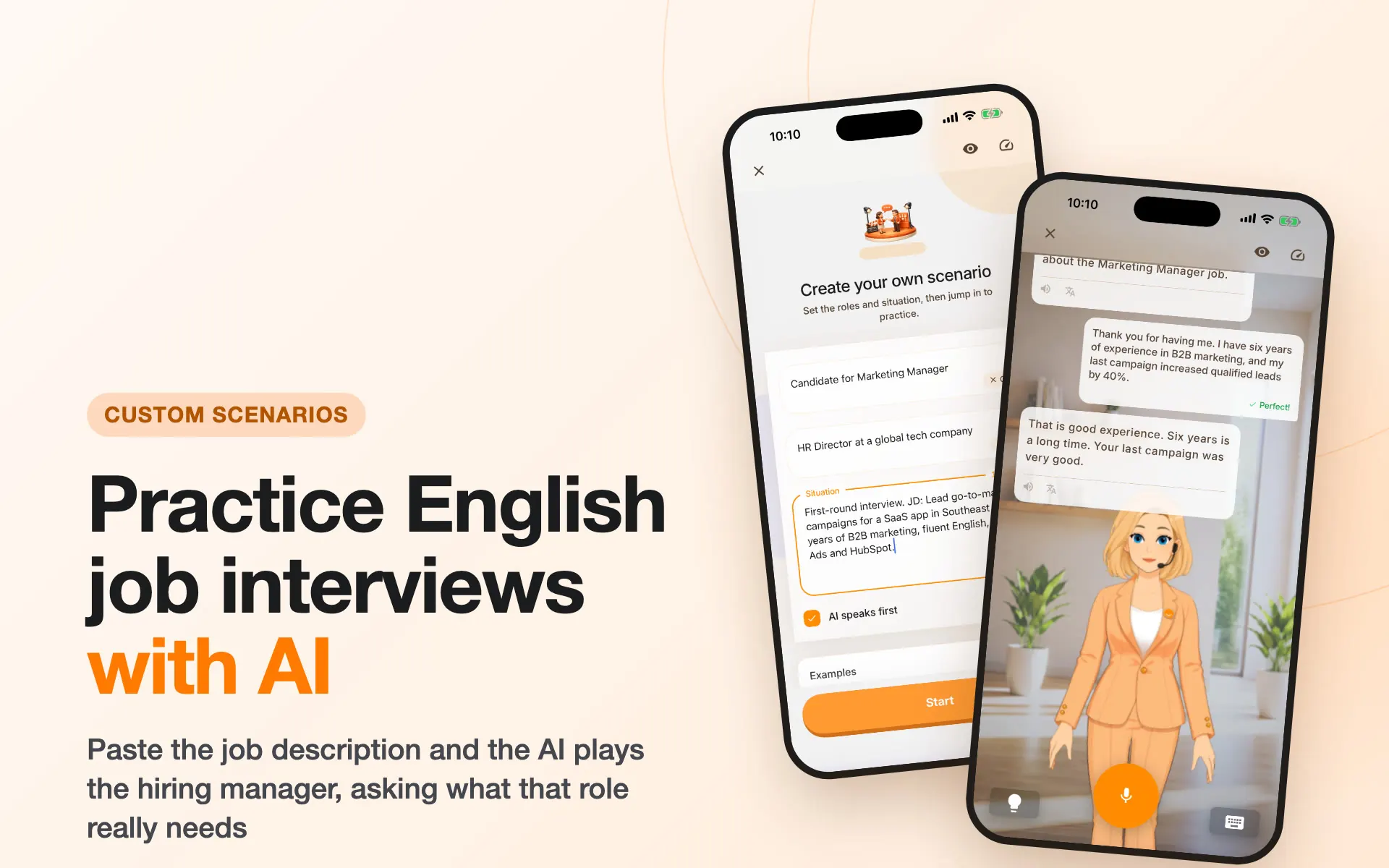
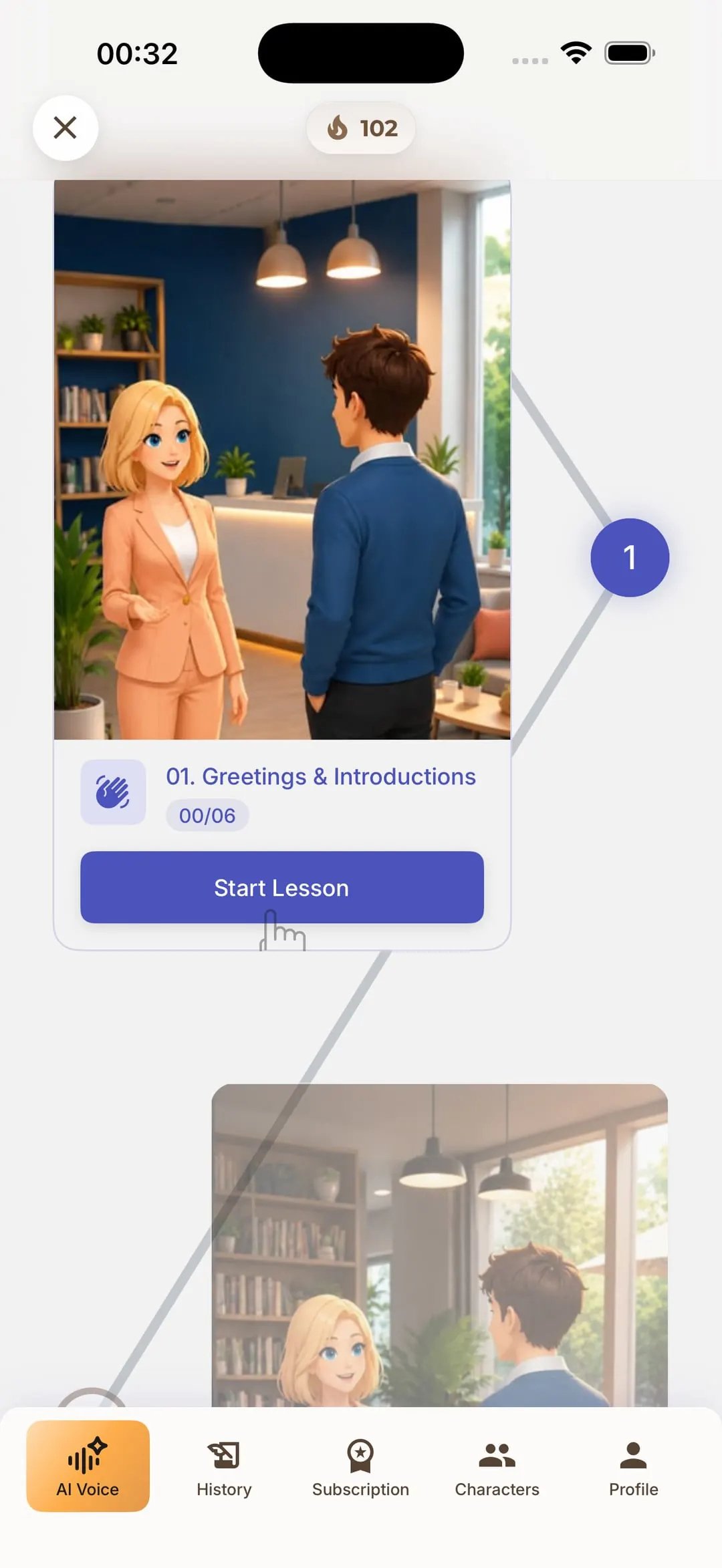
In Chamate, Journey mode turns topics into a day-by-day path where the AI asks and follows up like a friend would. You tap to talk and tap again to send, so you can pause as long as you need. You can replay every AI line to shadow it, and replay your own voice too, so methods 2 and 3 fit into the same session.
The Limit of Practicing Alone: My Story
In 2022, after five years in Russia speaking Russian almost every day, I came back to Vietnam with barely enough English to introduce myself. I never went to a language school and I don't have a certificate. Everything was self-study: vocabulary books, grammar books, films, YouTube, shadowing, and those demo videos recorded over and over.
After a while I noticed I was stuck in a strange spot. I could read fine and talk to myself fairly smoothly. But when a coworker spoke to me, I caught two or three words per sentence. When it was my turn, my mind went blank, because the words and grammar I knew had never had to connect under real time pressure. That freeze is more common than you'd think, and I dig into it in why vocabulary and grammar freeze when you speak English.
What changed things was real conversation. I got close to a few English-speaking friends at work, met a friend who teaches English, and joined English clubs. We just talked, hung out, and talked some more. About two months later, my reactions were noticeably faster.
Looking back, the years of self-study weren't wasted. They were the raw material. But it took someone asking unexpected questions to turn that material into reflexes. The catch is that not everyone has friends like that, and finding them is hardest exactly when you can't speak yet. That's why I built Chamate: someone to talk to at 11 p.m. who never judges your mistakes.
A 20-Minute Daily Plan to Build Speaking Reflexes at Home
You don't need long sessions. Twenty minutes a day, every day, beats two hours on the weekend. Here's the plan I'd follow if I were starting over:
| Day | First 10 minutes | Next 10 minutes |
|---|---|---|
| Monday | Shadow a short video clip | Talk with an AI about the clip's topic |
| Tuesday | Narrate yesterday and record it | Play it back, note one mistake, record once more |
| Wednesday | Learn 5 new chunks | Talk with an AI and try to use all 5 |
| Thursday | Random questions, 60 seconds each | Talk with an AI and let it follow up |
| Friday | Shadowing | Retell something from your week and record it |
| Weekend | Rest, or meet real people | English clubs, friends, coworkers |
Only have 15 minutes? How to practice English speaking with AI in 15 minutes a day has a tighter routine.
One more thing: don't wait until you feel “good enough” to talk with real people. My reflexes only got faster once I started having regular conversations, not when I studied more.