

I don't hold an IELTS certificate. I meant to take it, and TOEIC too, to make my CV look tidier, and then work swallowed the months and I never registered. So this isn't a band 8.5 holder sharing secrets. It's someone who went from not being able to finish a sentence to working in English every day, and who only afterwards sat down with the official Speaking band descriptors to understand what examiners actually measure.
What struck me reading them: three of the four criteria (fluency and coherence, vocabulary, grammar) improve through one thing, speaking a lot, every day, with someone correcting you. That's exactly what I did for two months to stop freezing. It's also the part AI does best. The fourth criterion, pronunciation, is where AI is weakest, and I'll be blunt about that.
This post is part of my series on how to practice English speaking with AI. Most of what you'll find when you search for AI IELTS speaking practice is either a list of apps or a vendor page selling band scores. This one starts from the band descriptors, says plainly which criteria AI helps with and which it doesn't, then shows how to set up a mock exam and a 4-week plan. One thing up front: Chamate, the app I build, does not score bands and does not grade pronunciation. I won't pretend otherwise.
The Short Answer
Practicing IELTS Speaking with AI works best when you use the AI to speak a lot and get corrected immediately: set it up as an examiner, run Parts 1, 2 and 3 for 15 to 20 minutes a day, review the sentences it corrected, and revise the words you looked up. AI clearly helps with fluency, vocabulary and grammar. For pronunciation and a band estimate, you still need a teacher or a mock with a real person.
The 4 Band Criteria, and What AI Can Do for Each
Examiners score IELTS Speaking on four criteria, each worth a quarter of the band: Fluency and Coherence, Lexical Resource, Grammatical Range and Accuracy, and Pronunciation. Before you pick a tool, look at each one and ask what an AI can actually do there.
| Criterion | What the examiner listens for | What AI does well | What AI can't do |
|---|---|---|---|
| Fluency and Coherence | Continuous speech, few hesitations, ideas that connect, staying on topic | Its strongest area. Lets you speak every day, asks endless follow-ups, never interrupts. Fluency only grows with volume, and AI is a listener that never tires | Can't recreate the pressure of a real exam room |
| Lexical Resource | Words that fit the context, some less common ones, paraphrasing when stuck | Good. Suggests more natural phrasing, lets you look up a word mid-sentence, saves it for review | Will happily feed you “fancy” words if you ask for hard ones instead of right ones |
| Grammatical Range and Accuracy | Varied structures, few errors, complex sentences used correctly | Good. Corrects grammar sentence by sentence as you speak, saves what needs work | Won't force you into varied structures if you keep speaking in simple sentences |
| Pronunciation | Intelligibility, word stress, intonation, connected speech | Limited. Lets you replay your own voice, and copy a model sentence | Most conversational AI doesn't grade pronunciation. You need a dedicated pronunciation app or a teacher listening live |
Look at that table and you'll see why I think AI suits IELTS Speaking: the first three criteria are all “speak a lot, get corrected, remember it.” That's exactly what most learners are missing, because in a class each student speaks for a few minutes per session, and at home there's nobody to listen. AI fills that gap.
Pronunciation is a different story, and I'd rather be honest: if pronunciation is your biggest weakness, a general conversational AI like Chamate is not your main tool. You need an app that grades pronunciation, or a teacher who points out individual sounds. Chamate lets you replay your own voice and copy model sentences, which helps, but it doesn't replace a human ear.
Can You Trust an AI Band Score?
Plenty of apps advertise “AI band scoring aligned with Cambridge criteria.” I'm an engineer who works on AI and speech, so let me be specific: those scores are estimates computed from a transcript of what you said, run through a model trained to imitate the descriptors. They're useful for tracking a trend, fewer hesitations this week than last, say. They don't predict your real result, because an examiner hears your voice, hears how you recover when stuck, and because microphone quality, background noise and your accent all make the machine mishear you.
Even the vendor pages say “for reference only” somewhere in the small print. Read that line. The right way to use an AI score: treat it like a bathroom scale. Good for knowing whether you're going up or down. Not something you put on a form.
Chamate doesn't score bands. I chose not to build that feature because I didn't want to hand people a number I know isn't reliable. The app focuses on what AI does well instead: letting you speak, correcting sentences, saving your mistakes and words for review.
Setting Up a Mock Speaking Test with AI: Part 1, Part 2, Part 3
The Speaking test runs 11 to 14 minutes in three parts. Part 1: the examiner asks about you, your home, work, hobbies, 4 to 5 minutes. Part 2: you get a cue card, 1 minute to prepare and 1 to 2 minutes to talk. Part 3: a deeper discussion of the Part 2 topic, 4 to 5 minutes. Each part demands a different kind of speaking, so drill them separately first, then combine them into a full run.
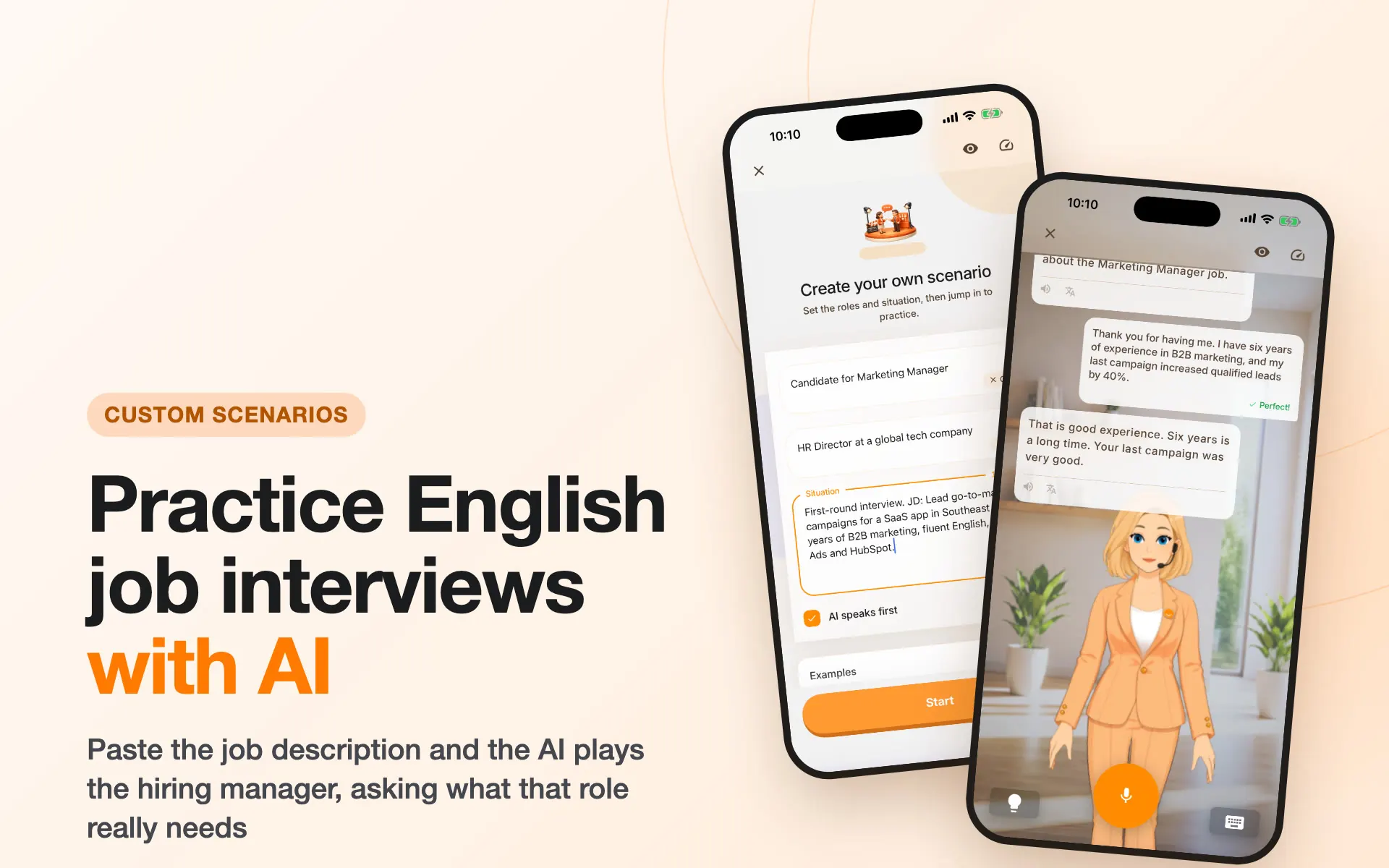
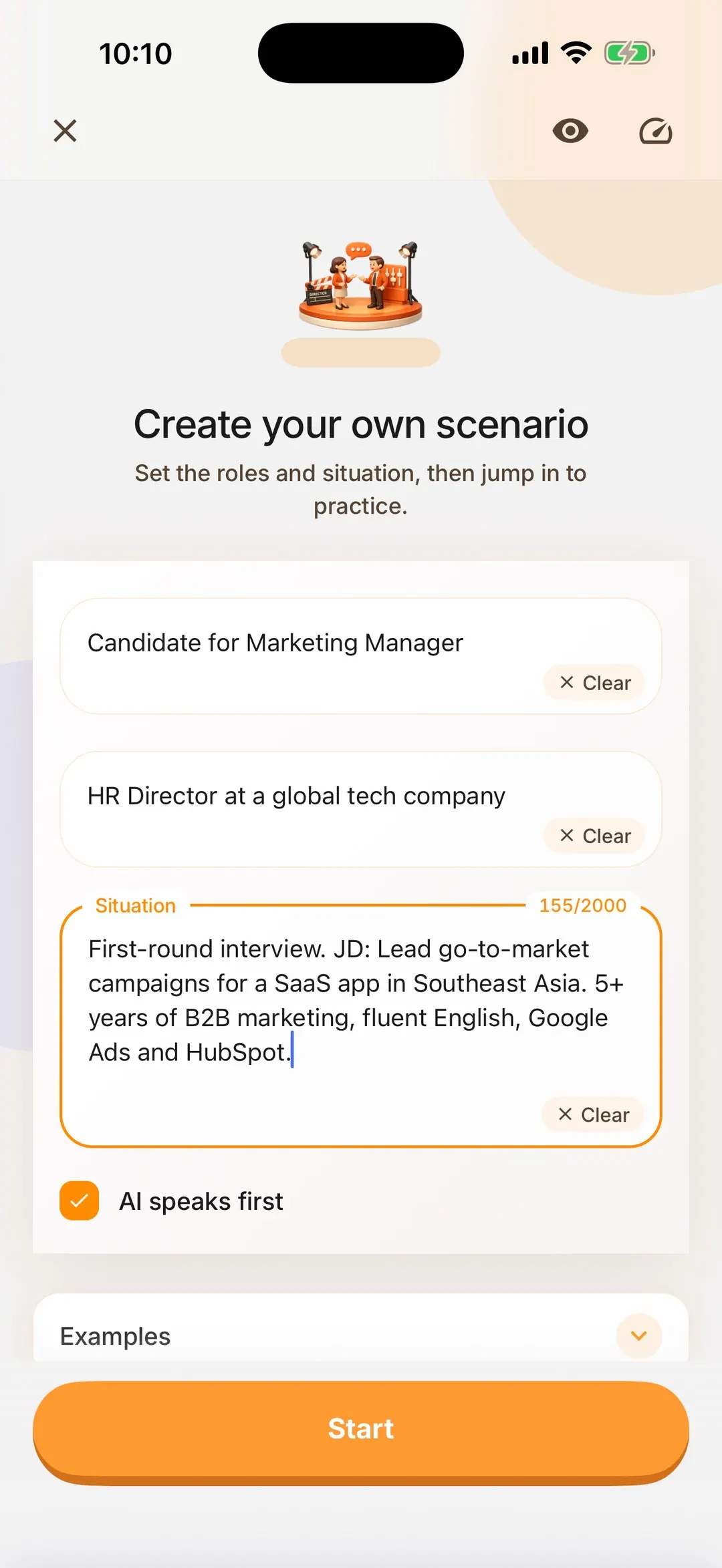
In Chamate you use the custom scenario feature: fill in your role, the AI's role, and the situation. It's the same setup as when you practice English job interviews with AI, except the person asking is an examiner instead of a recruiter. Here's a template for each part. Copy it and change the parts in brackets.
Part 1: questions about you
- Your role: IELTS Speaking candidate, target band [6.5].
- AI's role: IELTS examiner. Follow the Part 1 format, 3 to 4 questions per topic, don't help me answer, no feedback mid-test.
- Situation: Part 1, topics [work, hometown, morning routine]. Ask one question at a time and wait for my full answer. If my answer is too short, ask “Why?” or “Can you tell me more?”.
Part 2: cue card and the 2-minute monologue
Time yourself: 1 minute to prepare, 2 minutes to speak. Chamate uses tap to speak, tap again to send, so you can talk for the full 2 minutes without being cut off. This is where people get a surprise. Talking continuously for 2 minutes on a random topic is much harder than it sounds, and there's no way to train it except doing it over and over.
- Your role: IELTS Speaking candidate.
- AI's role: IELTS examiner. Read the task, then listen without interrupting.
- Situation: Part 2. Give me a cue card in the form “Describe a [person / place / event] that…” with 4 bullet prompts, and tell me I have 1 minute to prepare. After I finish, ask one short follow-up question, then move to Part 3.
Part 3: the discussion
Part 3 is where band 6 and band 7 separate. A band 6 candidate answers with one idea. A band 7 candidate gives the idea, a reason, an example, then looks at it from the other side. You can set the AI's level slightly above your own to get used to harder questions. Chamate lets you set the AI's level from A1 to C2 and its speaking speed, and keeps it consistent for the whole session.
- Your role: IELTS Speaking candidate.
- AI's role: IELTS examiner asking abstract questions: comparisons, causes, predictions about the future.
- Situation: Part 3, expanding on the [Part 2 topic]. Ask 5 to 6 questions, each harder than the last. If I only give one idea, ask “What makes you say that?”.
After Each Session: 4 Things That Turn 15 Minutes into a Score
Finish speaking and close the app, and you've wasted half the session. The other half is the 10 minutes afterwards:
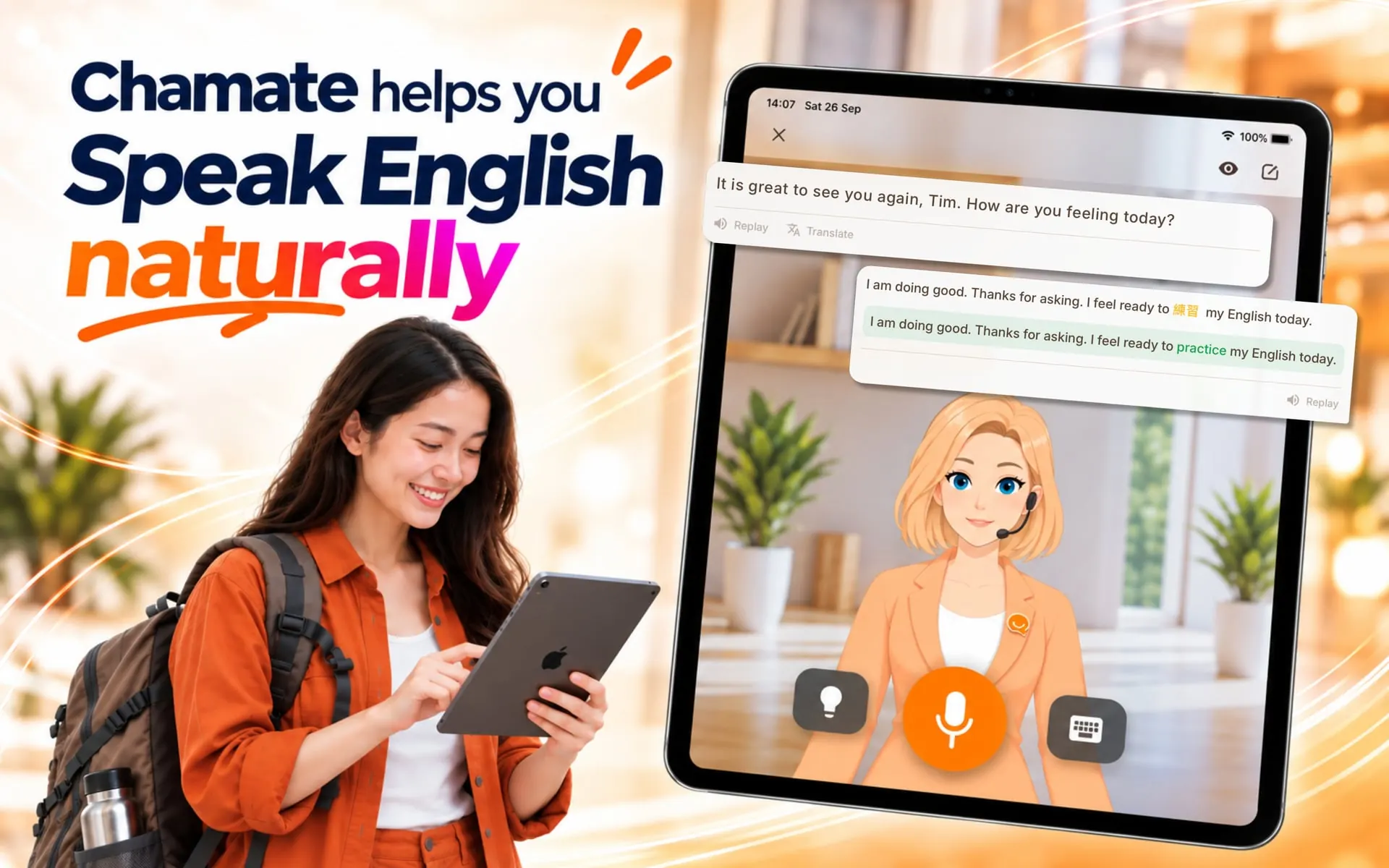
- Reread the corrected sentences. Chamate corrects grammar as you speak and saves a list of sentences to improve. Look for repeat offenders: dropped “s,” wrong tense when telling a past story in Part 2, missing articles. One repeated error fixed is a real gain in Grammatical Accuracy.
- Replay your Part 2. Count the “um”s and “uh”s, and note where you paused longer than 3 seconds. Compare next week.
- Revise the words you looked up. Any word you tapped during the session goes into your vocabulary list, with games to review it and a widget that puts it on your lock screen. That's your Lexical Resource growing with words you actually needed, not a “band 8 vocabulary” list copied from the internet.
- Do Part 2 again with the same cue card. The second attempt is always smoother. A real examiner won't give you a second attempt, but your brain needs one to lock in the structure.
A 4-Week Plan Before Test Day
If you have a month, this is how I'd split it. Each session 15 to 25 minutes, spoken out loud, not typed. Every week includes at least one session with a real person.
| Week | What to practice with AI | Goal by the end of the week |
|---|---|---|
| 1 | Part 1 every day, 2 to 3 topics per session. Train yourself to give 2 to 3 sentences per question, never one-word answers. | Answer any Part 1 question in 20 to 30 seconds without translating in your head |
| 2 | Part 2 every day, a new cue card each session, timed 1 + 2 minutes. Replay your voice after each one. | Fill the full 2 minutes on any card without a pause over 3 seconds |
| 3 | Part 3 every day, tell the AI to escalate difficulty. Drill the frame: idea, reason, example, other side. | Answer each Part 3 question in 40 to 60 seconds with an example |
| 4 | Full 11 to 14 minute mock with AI every other day, plus one mock with a teacher or friend. Last two days: revise words and replay only, nothing new. | Get through a full mock without looking at notes |
If you can't yet talk for 5 minutes straight on a familiar topic, take a step back and read how to practice speaking English alone at home first. The plan above assumes basic reflexes are already there.
6 Common IELTS Speaking Mistakes, and Which Ones AI Catches
- Memorizing model answers. Examiners are trained to spot them and will change the question to check. AI helps here by asking the unexpected: tell it “don't use questions from the common lists” and it'll ask things you haven't scripted.
- One-line answers in Parts 1 and 3. “Yes, I like it.” Then silence. Tell the AI to ask “Why?” whenever you answer in under 15 seconds. After a week you'll add the reason without being asked.
- Stuffing in “band 8 words” in the wrong place. “Ubiquitous” and “plethora” used out of context lose Lexical Resource points, they don't earn them. AI corrections will show you the more natural phrasing, which is usually simpler. I go deeper on this in how to speak English naturally like a native speaker.
- Skipping the timer in Part 2. Many people practice Part 2 untimed and discover in the exam room how long 2 minutes is. Always time it, even with AI.
- Only practicing topics you like. You like technology, so every week is about technology. The test might give you art, the environment, history. Tell the AI to pick a random topic, or the one you hate most.
- Translating in your head before speaking. This is the root of every other mistake, and AI can't fix it directly. It fixes it indirectly, by making you speak enough. I wrote about the mechanism in why you freeze when speaking English even though you know the words.
When You Need a Real Person
At least three moments. First, pronunciation: every week or two, have a teacher or a friend with a good ear point out the 2 or 3 sounds that make you hard to understand. Second, the mock: in the final week, one full mock with a real person, to get used to eye contact, to not being able to replay the question, to the pressure of being judged. Third, a band estimate: if you need a number to decide your test date, ask an IELTS teacher, not an app.
Everything else, which is 80 to 90 percent of your practice hours, is speak, correct, revise, speak again. AI does that part better than people, because it's free at 11 pm, doesn't get tired when you redo the same cue card a fifth time, and isn't shy about correcting you.
Final Thoughts
I have no band to show off. What I have is two months of speaking every day, getting it wrong constantly, getting corrected constantly, and ending up with the thing the IELTS descriptors call Fluency and Coherence. It's the criterion AI helps you with most, and the one most candidates are shortest on.
Don't buy a number. Buy speaking hours. Set the AI up as your examiner, do Part 1 this week and Part 2 next week, and keep one session a week with a real person for pronunciation. You can download Chamate and set up your first mock tonight. Your first Part 2 will stall at the 40-second mark. By your tenth, 2 minutes will feel short.